
Cants and slabs
Custom sawmill lines
Cant lines and slab lines adapted to your installation, or replacing the existing one.
Our approach
A line for each sawmill
We build machinery for cant lines and slab lines. Boards come out of the cant at the multi-rip saw, which normally closes the line. Boards also come out of the slabs left by the edger: depending on the installation, they go to their own line.
Each line is adapted to the sawmill or replaces the existing one. Here you can see the usual layout; the final one is worked out with you.
Adapted to your installation
- Curved sections
- Rollers
- Inclines
- Photocells
- Sensors
- Limit switches
- Parameter adjustment
Or it replaces the existing line.
Typical lines
Cants and slabs
Usual layout of each line. Tap a code to see the machine.
Typical cant line
Usual layout for long cants · the multi-rip saw, which produces the boards, normally closes the line-
01
Edger
-
02
Optional
Splitter
-
03
Trimmer
-
04
Multi-rip saw
Typical slab line
Usual layout · boards also come out of the slabs-
01
Optional
Centring device
-
02
Slab edger
-
03
Slab trimmer
-
04
Optional
Singulator
-
05
Slab multi-rip saw
The configuration of the lines, both cant lines and slab lines, depends on the customer's sawmill.
- Optional depending on the installation
- B43 alternative at the same step
- cutting line
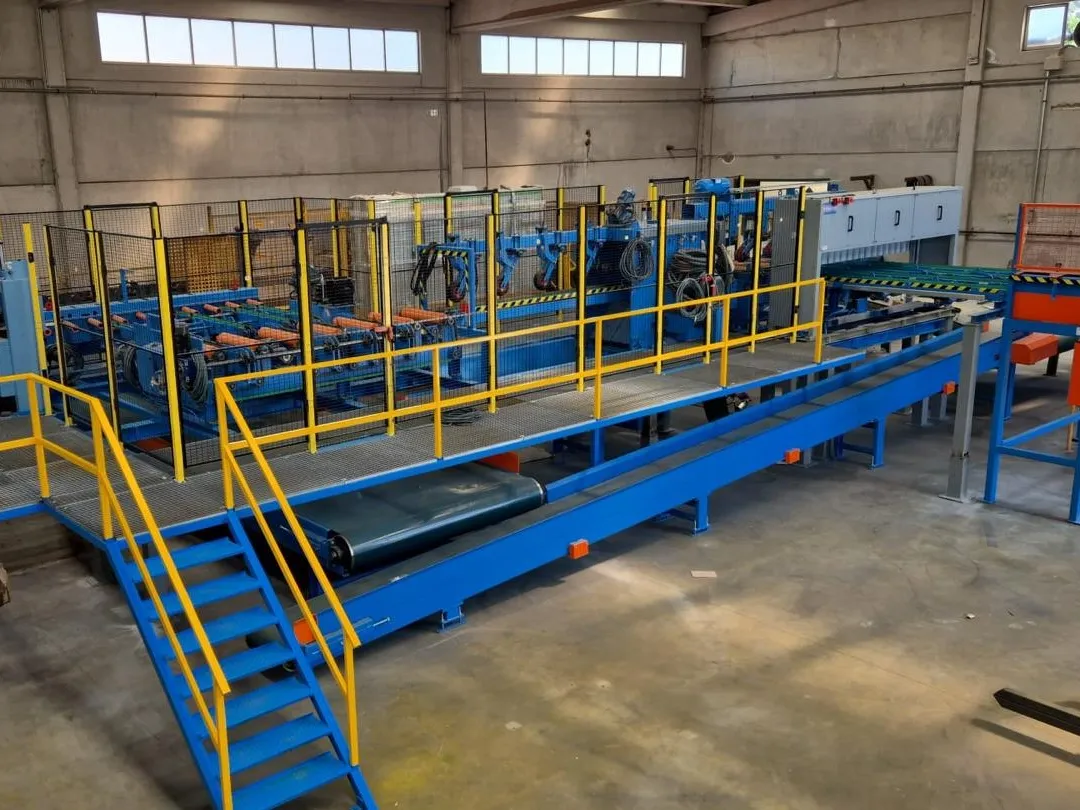
Cant line: step by step
The timber moves from left to right. This is the usual layout: each line is worked out with the customer, and the optional steps depend on the installation.
- Automatic cant edger B27N. It cuts the sides of the cant with two independent heads. The slabs come out of it and, depending on the installation, go to their own line.
- Cant splitter B41 (optional). It cuts the cant horizontally through the centre into two stacked pieces, which are then separated.
- Trimmer B30. It cuts the ends to an exact length. After the splitter, it receives one piece at a time.
- Multi-rip saw B24N or B43. It cuts the boards; the multi-rip saw also receives one piece at a time. The B24N is a multi-rip saw with a double vertical arbor of circular saw blades; the B43 is horizontal, with a single arbor, and cuts boards from planks.
Slab line: step by step
Boards also come out of the slabs left by the edger. Depending on the installation, they go to a line of their own; this is its usual layout.
- Slab centring device (optional). It centres the slab so that it enters the edger correctly positioned; semi-automatic infeed.
- Slab edger. It cuts the sides of the slab, the half-moon piece that comes off the edging.
- Trimmer B30. The same multi-purpose trimmer cuts the ends to an exact length.
- Singulator (optional). It separates the slabs and feeds them one at a time to the multi-rip saw.
- Slab multi-rip saw B42. It cuts boards from the slabs: it adjusts the board width automatically, accepts an automatic infeed and has a rear safety outfeed tunnel.
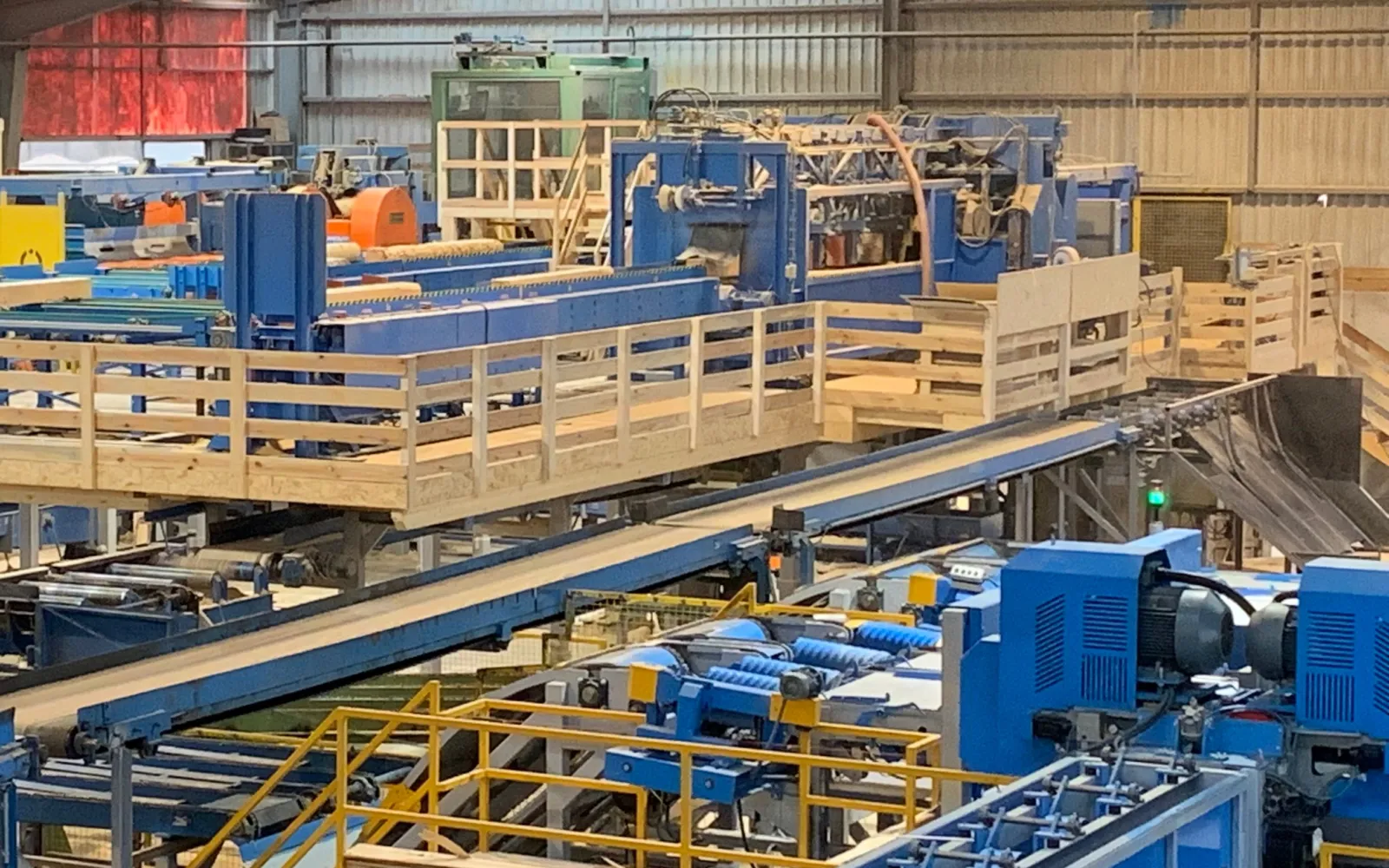
The layout of each line is worked out with each sawmill: timber, production and available space.
Tell us about your sawmillFrequently asked questions about the lines
What is the difference between a cant line and a slab line?
The cant line works the cant, from which boards come out at the multi-rip saw. The slab line works the slabs left by the edger and also ends in a multi-rip saw. Depending on the installation, both can coexist in the same sawmill.
Can you replace an existing line, or just one machine?
Both: we install complete lines, which replace the existing one or are adapted to it, and also individual machines, such as a B24N multi-rip saw with custom infeed and outfeed. Sometimes part of the previous machines is kept. You can see examples in Projects.
What do you need to propose a line?
The timber you work with, the production you are looking for and the space you have available. The final layout is worked out with you.
Let's talk about your sawmill
We build and advise. We get involved in your production.